
Power Platform governance for SMBs is one of the most overlooked risks in the Microsoft ecosystem today.
Microsoft Power Platform — Power Apps, Power Automate, Power BI, and Copilot Studio — has made it easier than ever for everyday employees to build apps, automate workflows, and create reports without writing a single line of code. For growing businesses, this sounds like a dream.
But without governance, it quickly becomes a nightmare.
This post covers exactly what happens when Power Platform is deployed without rules — and what you can do about it before the problems become expensive.
What Is Power Platform Governance and Why Does It Matter?
Power Platform governance is the framework of policies, controls, and processes that define how Power Apps and Power Automate are built, deployed, and managed across your organization.
It answers questions like:
- Who is allowed to create apps and flows?
- Which connectors can connect to which data sources?
- How do solutions move from development to production?
- Who owns an app when the person who built it leaves the company?
- What happens when an automated flow breaks and nobody knows why?
Without answers to these questions, Power Platform governance for SMBs becomes reactive — you fix problems after they happen instead of preventing them in the first place.
What Actually Happens When There Are No Rules
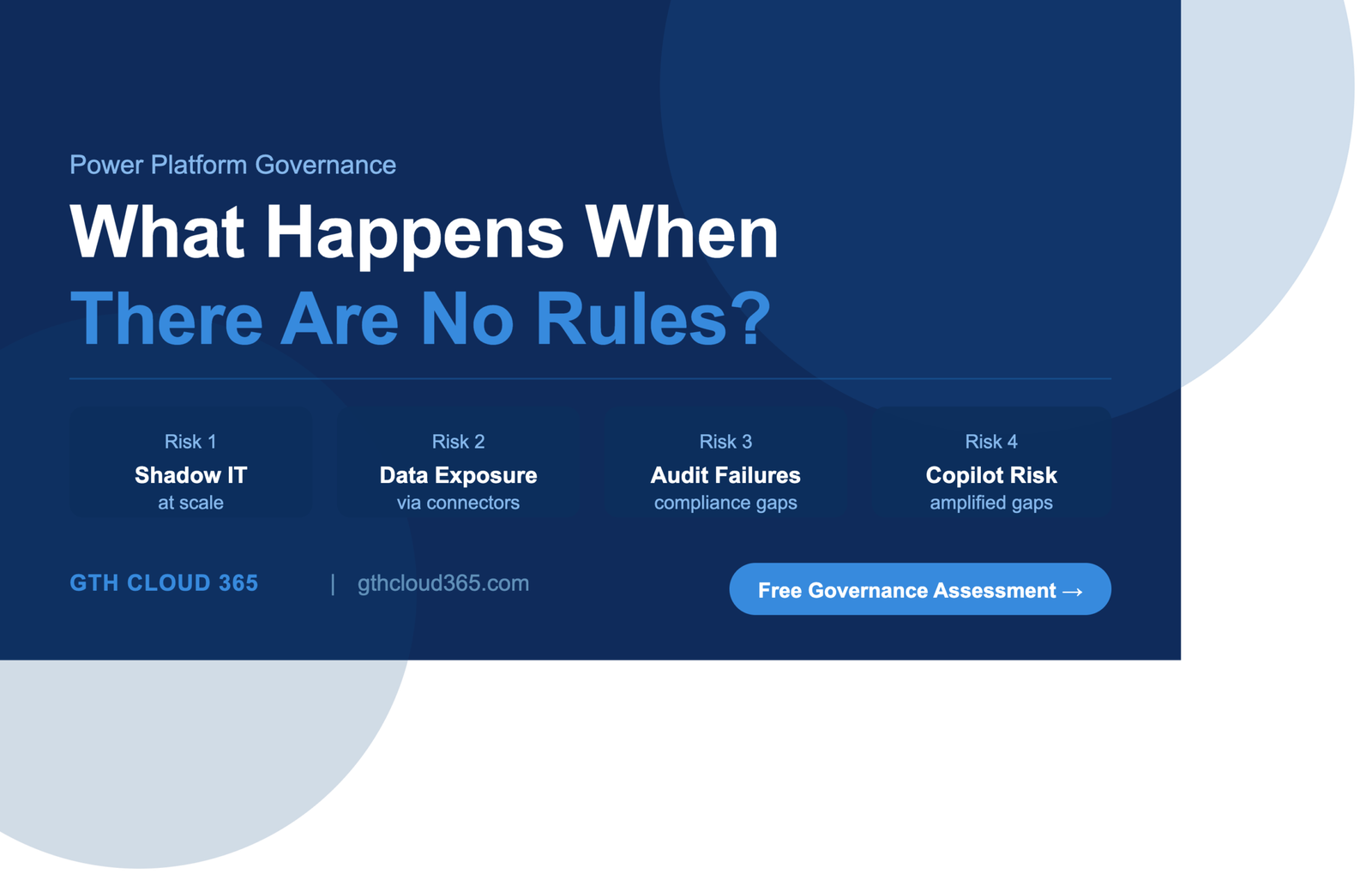
1. Shadow IT Explodes Overnight
Power Platform is designed to be easy. That is its greatest strength and its biggest governance risk.
When employees discover they can build apps and automate workflows without involving IT, they do exactly that. Within months most organizations end up with dozens — sometimes hundreds — of apps and flows built by people across finance, HR, operations, and sales with no visibility, no documentation, and no oversight.
This is shadow IT at scale. And unlike traditional shadow IT where someone installs an unauthorized application, Power Platform shadow IT is deeply embedded in your business processes. Flows are triggering payroll updates. Apps are reading from your customer database. Reports are pulling from live SharePoint data.
When something breaks — and it will break — nobody knows where to start.
2. Sensitive Data Goes Wherever Flows Take It
Power Automate can connect to hundreds of external services through connectors — Dropbox, Gmail, Twitter, Slack, and thousands of others. Without Data Loss Prevention policies in place, a well-meaning employee can build a flow that sends customer records to a personal Dropbox account or posts confidential data to an external Slack channel.
This is not hypothetical. It happens regularly in organizations that have not implemented Power Platform governance for SMBs. And when it happens, the consequences include compliance violations, data breach notifications, and in regulated industries, significant fines.
DLP policies in Power Platform governance define which connectors can be used together and which are blocked entirely. Without them your data can travel anywhere.
3. Nobody Owns Anything When Someone Leaves
One of the most common Power Platform governance failures we see at GTH Cloud 365 is the orphaned app problem.
An employee builds a critical app — let us say a leave request system used by 50 people every week. They leave the company. The app is owned by their account. Their account is deleted. The app stops working. Fifty people cannot submit leave requests and nobody knows who built it, how it works, or how to fix it.
This scenario plays out constantly in organizations without governance controls. A proper Power Platform governance framework includes co-ownership policies, environment strategy, and solution documentation that prevents a single person’s departure from breaking a business process.
4. You Cannot Pass an Audit
If your organization is subject to any compliance framework — HIPAA, SOC 2, ISO 27001, GDPR, or even basic cyber insurance requirements — ungoverned Power Platform is a red flag.
Auditors want to know what data your systems process, who has access, how access is controlled, and what happens when something goes wrong. If your answer involves dozens of citizen-developer flows with no documentation, no access controls, and no change management — you are not audit ready.
Power Platform governance for SMBs does not have to be complex. But it does have to exist.
5. Copilot Makes Every Existing Risk Worse
If you are planning to deploy Microsoft Copilot — or have already enabled it — ungoverned Power Platform multiplies your risk significantly.
Copilot can interact with Power Platform. It can trigger flows, query apps, and surface data based on what users have access to. If your Power Platform environment has no DLP controls, no environment strategy, and no access governance — Copilot will operate inside those same gaps.
Before enabling any AI capability in Microsoft 365, Power Platform governance must be in place. It is not optional.
What Good Power Platform Governance Looks Like
Effective Power Platform governance for SMBs does not require a large IT team or enterprise-level complexity. It requires the right framework applied consistently. Here is what that looks like in practice:
Environment Strategy
Three environments minimum — Development, Test, and Production. Apps and flows are built in Development, tested in Test, and only promoted to Production through a controlled process. No citizen developer builds directly in Production.
DLP Policies
Data Loss Prevention policies define which connectors are allowed, which are blocked, and which can only be used with specific data sources. At minimum block all personal storage connectors (Dropbox, personal OneDrive, personal Gmail) from connecting to business data sources.
Azure DevOps ALM
Application Lifecycle Management using Azure DevOps ensures that every solution promotion from Development to Production is tracked, reviewed, and reversible. This is how you prevent the orphaned app problem and maintain a full audit trail of changes.
Maker Governance
Define who can create environments, who can build apps, and who can publish flows to Production. Not every employee should have maker access. A tiered model — citizen developer, pro developer, admin — gives the right people the right level of access.
Solution Documentation
Every app and flow in Production should have a documented owner, a business purpose, and a handover plan. This takes ten minutes per solution and saves hours of investigation when something breaks.
Key Takeaways for SMBs
- Power Platform without governance creates shadow IT, data exposure risk, and audit failures — not immediately, but inevitably
- The longer you wait to implement governance, the more difficult and expensive the cleanup becomes
- DLP policies, environment strategy, and ALM are the three foundations of Power Platform governance for SMBs
- Copilot adoption without Power Platform governance in place amplifies every existing risk
- Good governance does not slow citizen development down — it gives citizen developers a safe runway to build on
Is Your Power Platform Environment Governed?
Most SMBs do not know the answer to that question — and that is exactly the problem.
GTH Cloud 365 offers a free Power Platform Governance Assessment for SMB and mid-market organizations. In one session we identify your top governance gaps, DLP risks, and orphaned solutions — and provide a clear roadmap to get your environment under control.
No obligation. No sales pressure. Just specific, actionable guidance for your Power Platform environment.
Request Your Free Power Platform Assessment →